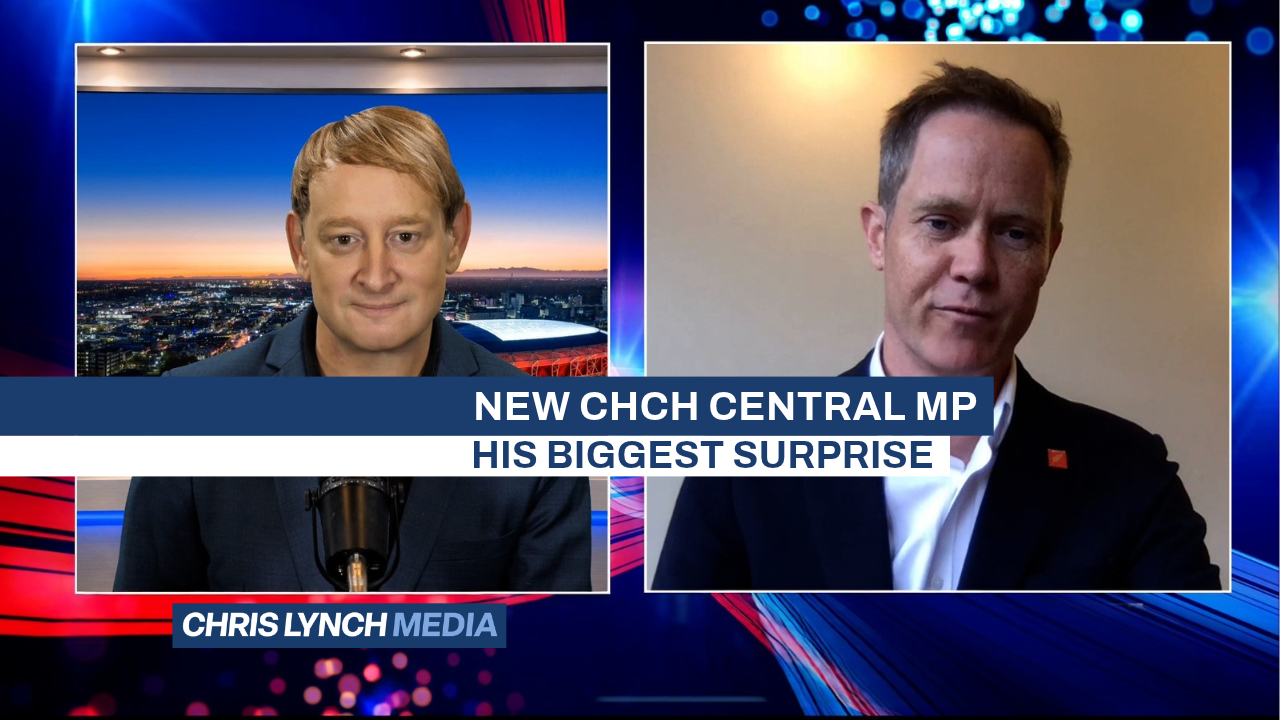
Escaped youth tracked by Eagle helicopter, found hiding in New Brighton
The young person who escaped from a youth justice facility in Rolleston has been located...


The young person who escaped from a youth justice facility in Rolleston has been located...

A person has been seriously injured on State Highway 75, Christchurch Akaroa Road. A police...

BodyFix Gym Christchurch in Phillipstown has taken out two major honours at the Exercise New...

Local MPs have found areas of agreement on major Resource Management Act reforms, during a...

A series of public events have been organised across Christchurch and Lyttelton over the coming...

A woman was taken to hospital after a ‘water incident’ at Parakiore Recreation and Sport...

Radio New Zealand is preparing to cut the equivalent of almost 60 full time jobs after revealing an $11.8 million financial loss, serious failures in its internal financial reporting and a $5 million overdraft arrangement entered into without the required ministerial approval.
The publicly funded broadcaster’s annual report for the year ended 30 June 2026 reveals the extent of its financial difficulties, with the deficit more than 25 times the $470,000 loss originally budgeted.
RNZ recorded an after tax deficit of $11.846 million, compared with a loss of $886,000 the previous year.
The financial problems have prompted an independent review into the organisation’s reporting, financial controls and governance, while management prepares to make substantial cuts to its workforce.
RNZ is now planning to reduce staffing by the equivalent of 58 full time positions by the end of March 2027, subject to the required employment processes.
That is considerably more than the 25 to 30 positions the organisation announced it intended to cut in August.
The reduction would represent approximately one in six staff, based on the 347.6 full time equivalent employees recorded at the end of June.
Chief executive Paul Thompson accepted responsibility for the financial result, acknowledging that management failed to respond adequately to declining funding.
“This was not the outcome RNZ anticipated or one that management regards as acceptable. We recognise this is a poor result, and it deserves a clear explanation.”
The report reveals RNZ’s internal financial information did not accurately reflect the organisation’s actual position throughout the year.
The full extent of the problem became apparent in October, during preparation of the annual accounts and the audit process.
Thompson acknowledged the consequences of that failure. “RNZ did not reduce its cost base in response to the decline in its baseline funding.”
The broadcaster’s government funding and fees fell from $71.7 million to $67.3 million, while total expenditure increased from $76.9 million to $82.4 million.
Personnel expenses reached $47.2 million, exceeding the budget by $3.2 million. Operating expenses were $32.1 million, approximately $6.4 million above budget.
The annual report identifies several reasons for the overspending, including the relocation of RNZ’s Auckland operations and costs associated with selling or preparing properties for disposal.
These included $1.85 million in Auckland office relocation costs, $1.1 million in asset write offs, $1 million associated with decommissioning transmission towers at Henderson and $1.7 million in remediation costs linked to the sale of the Titahi Bay property.
Another significant accounting problem involved $2 million from proposed land sales being incorrectly treated as revenue in the original budget.
The broadcaster also incurred $1.374 million in redundancy payments and other employment cessation costs involving 22 staff during the financial year.
Despite the job losses and financial pressure, remuneration disclosures show 207 employees received more than $100,000 in total annual remuneration, compared with 178 the previous year.
Thompson received $611,000 in total remuneration, comprising $528,000 in salary, $24,000 in superannuation and a $59,000 performance payment. His total remuneration was $582,000 the previous year.
The annual report also discloses a breach of the Crown Entities Act 2004 involving RNZ’s borrowing arrangements.
In June, RNZ entered into a $5 million overdraft facility without obtaining the required approval from the Minister for Media and Communications and the Minister of Finance.
The organisation had previously received ministerial approval in 2006 for borrowing of up to $3.5 million.
Although RNZ did not exceed that earlier borrowing limit, the decision to establish the larger facility without fresh approval breached the legislation.
The maximum amount actually drawn during the year was $2.3 million, and the overdraft was undrawn at 30 June.
The independent auditor specifically drew attention to the breach in its report, while making clear that it did not alter the audit opinion on the financial statements.
RNZ also entered into a separate $3.7 million arrangement involving the sale and leaseback of technology equipment installed at its new Auckland premises.
At the time the annual report was prepared, the broadcaster was seeking advice on whether that transaction also required ministerial approval.
The financial difficulties have had a substantial impact on RNZ’s available cash.
Cash and cash equivalents fell from $18.8 million to $8.5 million during the year, a reduction of more than $10 million.
RNZ has also warned of another projected deficit of approximately $7.8 million in the current financial year, with management aiming to stabilise its finances in 2027/28.
The broadcaster is seeking to reduce ongoing operating costs by at least five percent as part of its financial recovery.
Former RNZ board chairman Dr Jim Mather, whose eight year tenure ended in June, described the financial result as extremely disappointing.
He acknowledged the distinction between the executive’s responsibility for financial management and the board’s responsibility for oversight, while accepting that financial stewardship was ultimately a collective governance responsibility.
An independent review will examine why the reporting failures were not identified earlier and whether RNZ had adequate financial controls and assurance arrangements.
The release of the annual report follows the unexpected departure of chief financial officer Hilary Parker on 2 October.
Her resignation prompted an emergency board meeting, after which director Richard Dellabarca was appointed interim chief financial officer.
Board chairman Brent Impey previously said Parker had resigned voluntarily and there was no suggestion of criminality.
Thompson, who has led RNZ since 2013, is also preparing to leave the organisation at the end of December.
NZME executive Jason Winstanley is due to take over as chief executive in 2027, with RNZ Chief News Officer Mark Stevens serving as interim chief executive from January until his arrival.