Escaped youth tracked by Eagle helicopter, found hiding in New Brighton
The young person who escaped from a youth justice facility in Rolleston has been located...


The young person who escaped from a youth justice facility in Rolleston has been located...

A person has been seriously injured on State Highway 75, Christchurch Akaroa Road. A police...

BodyFix Gym Christchurch in Phillipstown has taken out two major honours at the Exercise New...

Local MPs have found areas of agreement on major Resource Management Act reforms, during a...

A series of public events have been organised across Christchurch and Lyttelton over the coming...

A woman was taken to hospital after a ‘water incident’ at Parakiore Recreation and Sport...

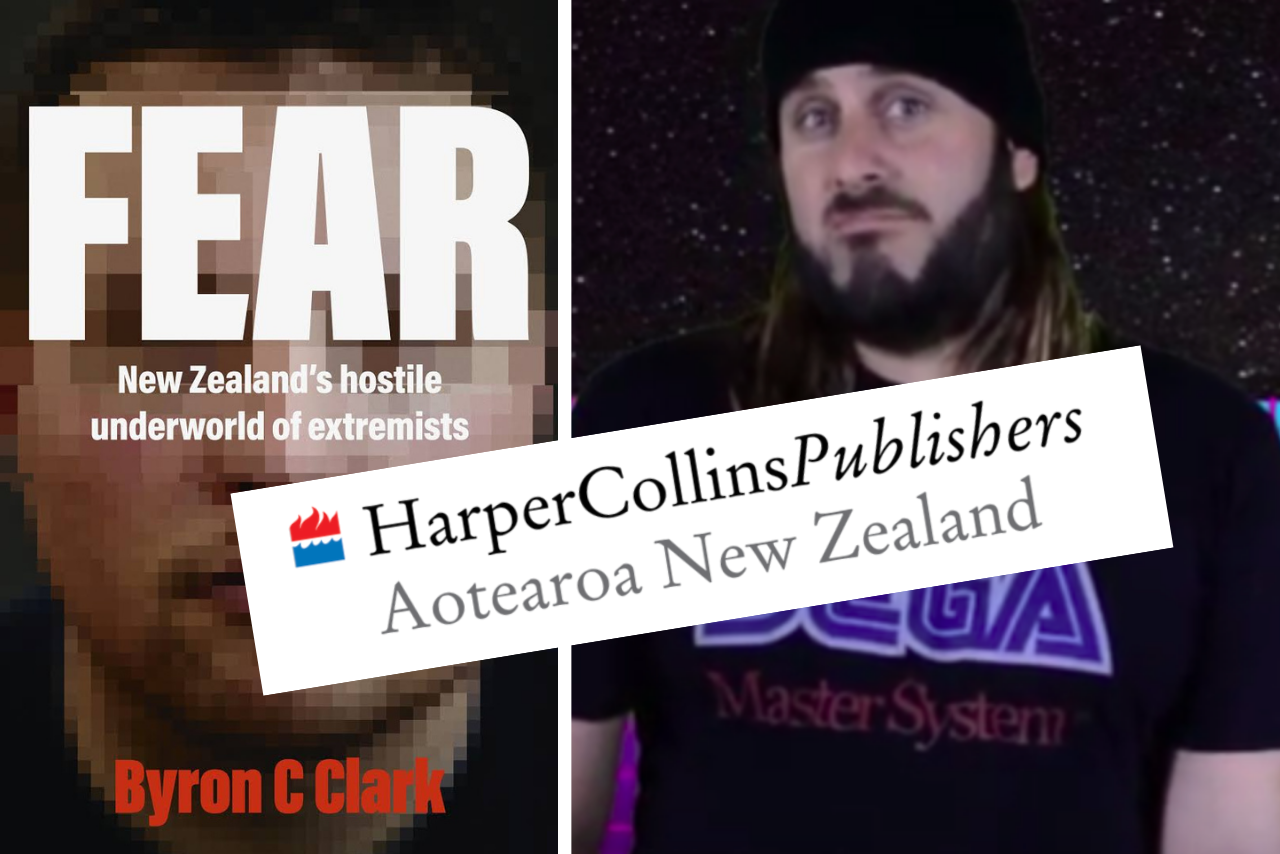
HarperCollins and author Byron Clark have publicly apologised to Conservative Party leader Helen Houghton after she challenged her inclusion in a chapter about the Alt Right in Clark’s book Fear: New Zealand’s hostile underworld of extremists.
The settlement is significant because Clark was regularly presented by New Zealand media outlets as a researcher and commentator on far right extremism, while his work was given substantial exposure through outlets including RNZ and The Spinoff.
Houghton objected to being named in a chapter titled “Women and the Alt Right”, arguing that placing her in that context could lead readers to believe she associated with, or shared the views of, far right extremists.
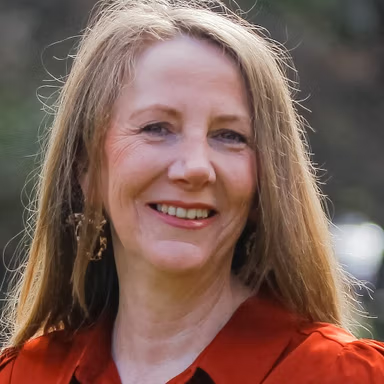
Helen Houghton. Conservative Party Leader
An edited version of the chapter was also published by The Spinoff in February 2023, extending the material beyond the book itself.
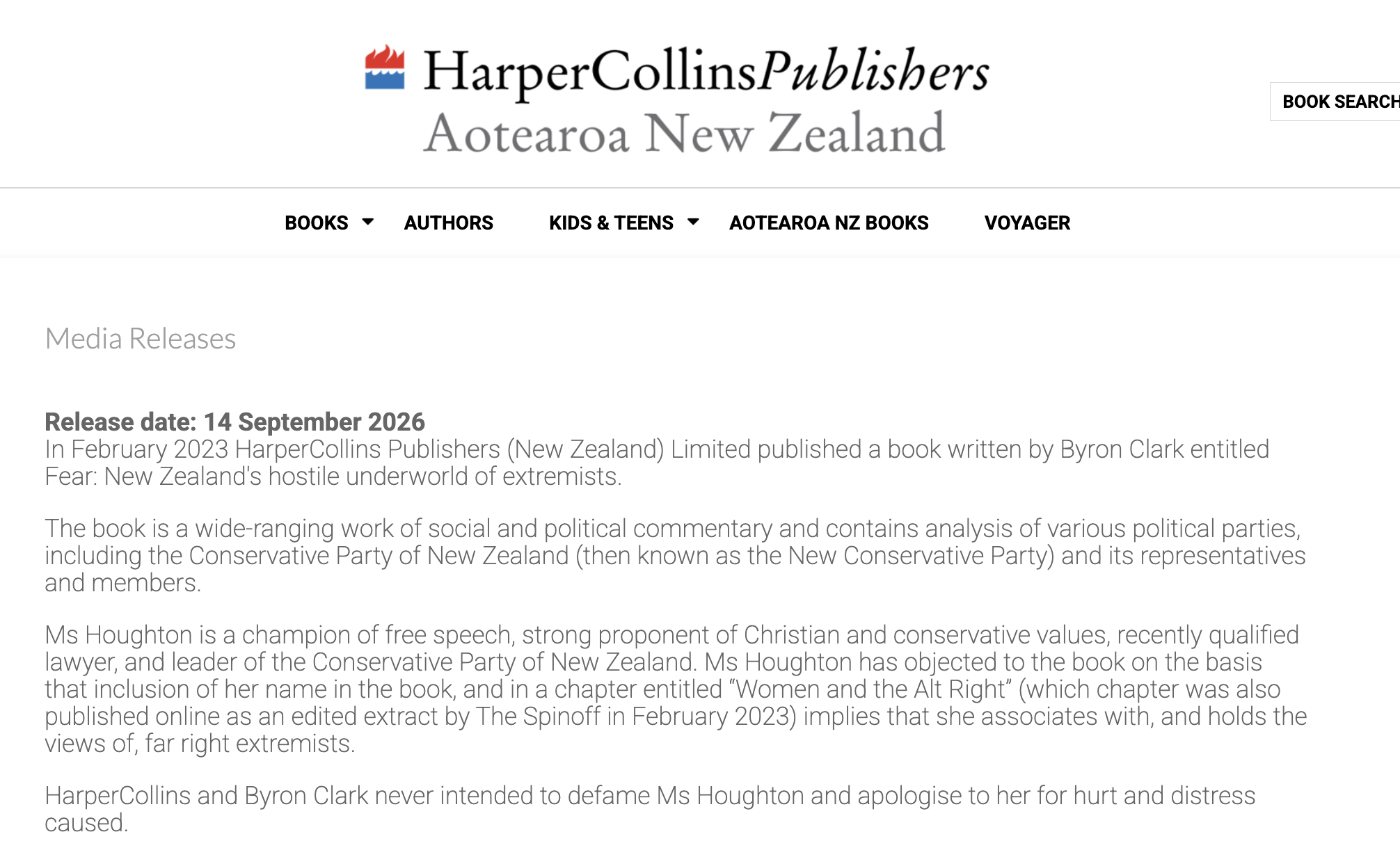
HarperCollins has now been forced to published a settlement statement acknowledging Houghton’s objection and issuing an apology.
“HarperCollins and Byron Clark never intended to defame Ms Houghton and apologise to her for hurt and distress caused.”
The statement describes Houghton as “a champion of free speech, strong proponent of Christian and conservative values, recently qualified lawyer, and leader of the Conservative Party of New Zealand.”
Houghton said the outcome showed the consequences of attaching extremist labels to people because of their political or religious views.
“This is a win for freedom of speech and for every New Zealander who believes that holding conservative, Christian or traditional values should not automatically result in being labelled an extremist,” she said.
“I have never accepted that advocating for strong families, personal responsibility, freedom of speech, limited government and Christian values makes someone an extremist.”
Houghton said the chapter title itself carried an implication that she was not prepared to accept.
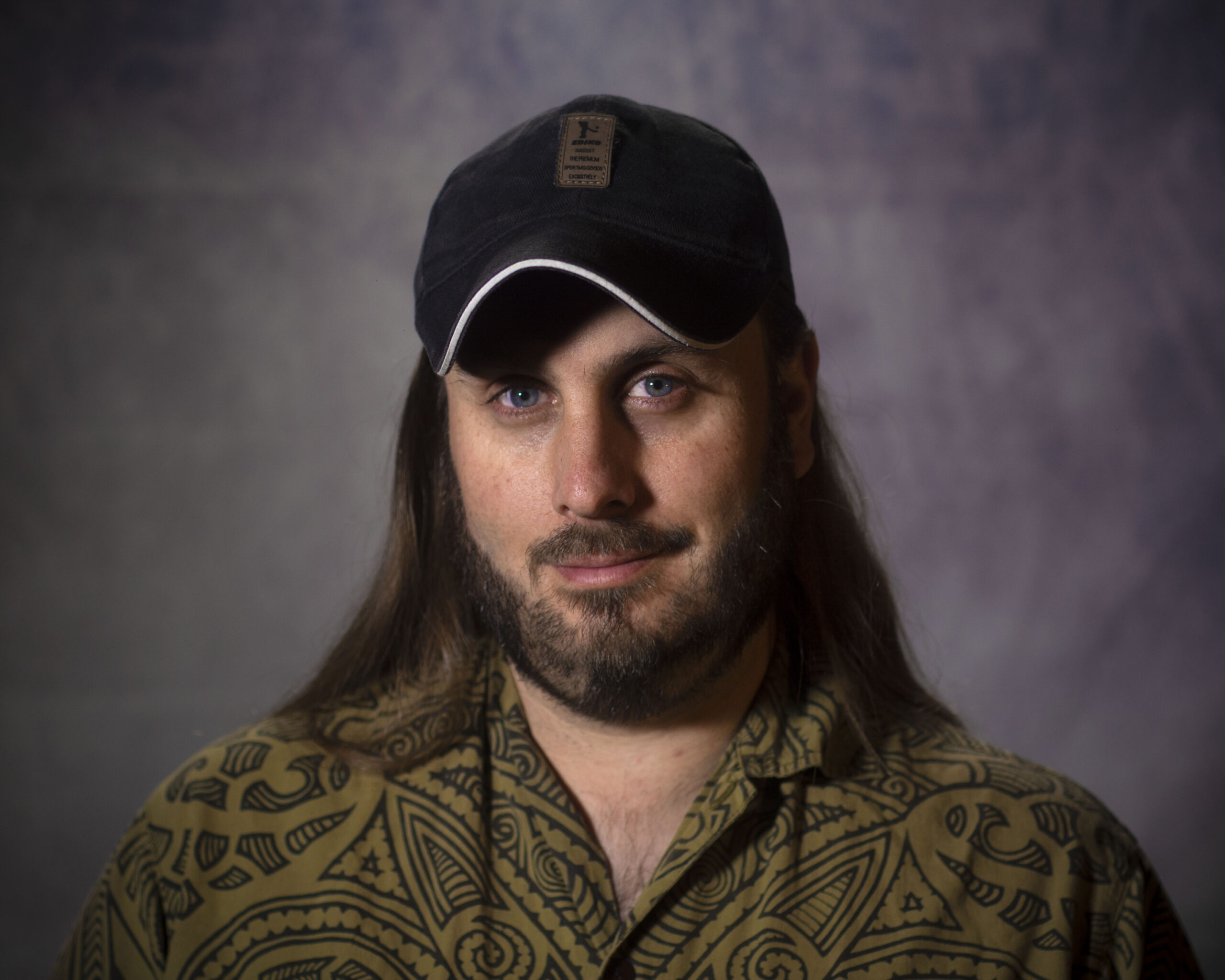
Byron Clark
“When someone’s name is placed in a chapter about the ‘Alt Right’ and extremists, readers can reasonably draw conclusions about that person’s beliefs and associations. I was not prepared to simply accept that implication.”
“I stood up for myself, but I also stood up for a principle. Conservatives should not be intimidated into silence because someone might attach a label to them.”
Clark’s commentary on extremism had previously been given considerable prominence in New Zealand media coverage.
RNZ has described him as a researcher on conspiracy movements, while The Spinoff has presented him as an authority on far right and alt right extremism.
That makes the public apology particularly significant, given Houghton’s central complaint was that Clark’s work placed her in a context she believed associated her with extremist politics.
Houghton said freedom of expression also meant protecting people from being falsely associated with ideologies they did not support.
“Conservatives believe that people should be free to express their political, religious and social views without being vilified or falsely associated with movements or ideologies they do not support.”
“We do not believe that freedom of speech belongs only to people whose opinions are politically acceptable at the time. It belongs to everyone.”
The book was published in February 2023 and included commentary about political groups and individuals in New Zealand, including the Conservative Party, which was then known as the New Conservative Party.
Houghton said she regarded the settlement as bigger than her individual dispute with the publisher. “You cannot claim to support freedom of speech while remaining silent when people are publicly characterised because of the political or social views they express.”
“This is why I fought this matter. I will continue to speak, and I will continue to stand up for the right of others to speak too.”
Chris Lynch Media has asked HarperCollins whether it accepts Houghton should not have been included in the chapter, whether any payment formed part of the settlement, whether future editions will be changed, and whether the publisher continues to stand by the original editorial decision.