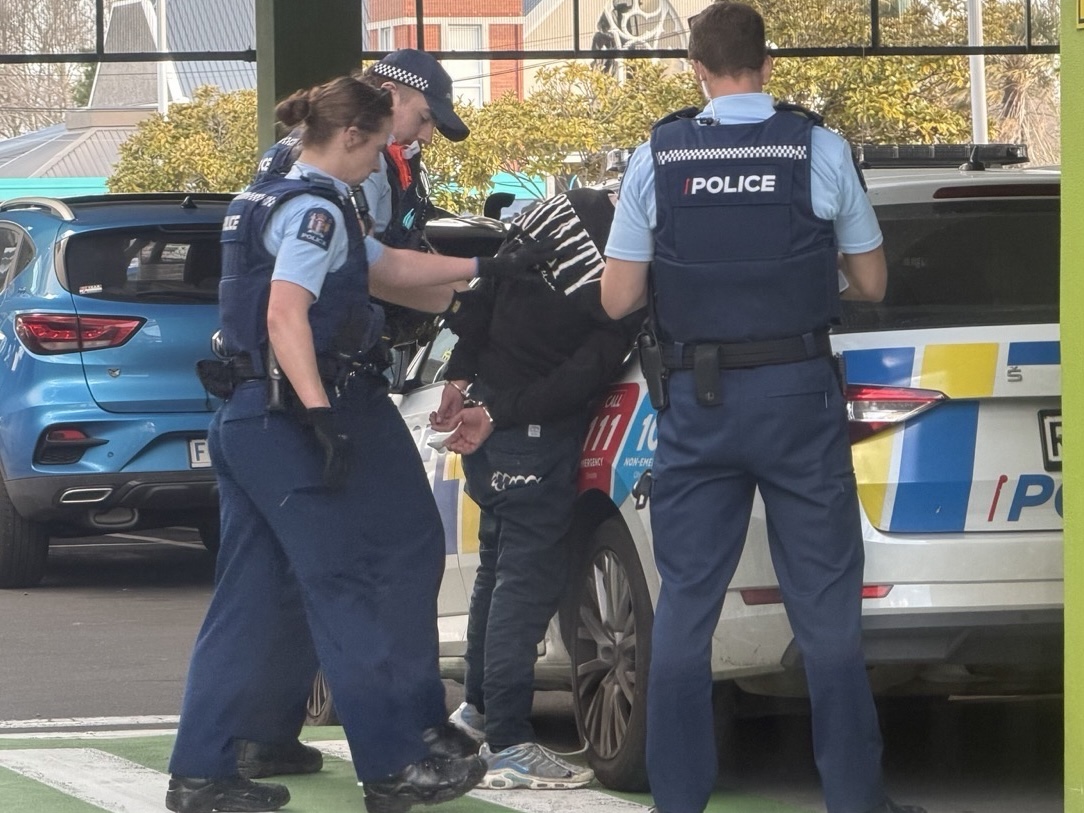
Escaped youth tracked by Eagle helicopter, found hiding in New Brighton
The young person who escaped from a youth justice facility in Rolleston has been located...


The young person who escaped from a youth justice facility in Rolleston has been located...

A person has been seriously injured on State Highway 75, Christchurch Akaroa Road. A police...

BodyFix Gym Christchurch in Phillipstown has taken out two major honours at the Exercise New...

Local MPs have found areas of agreement on major Resource Management Act reforms, during a...

A series of public events have been organised across Christchurch and Lyttelton over the coming...

A woman was taken to hospital after a ‘water incident’ at Parakiore Recreation and Sport...


A 27 year old Christchurch mother was examined at Christchurch Hospital, given morphine and advised to see her GP. Four days later, she lost her right ovary and appendix during emergency surgery.
Kaitlin said her surgeon later told her the ovary could have been saved if she had undergone surgery within 48 hours of her first hospital visit.
She arrived at the emergency department early on Saturday 25 July with excruciating pain in the lower right side of her abdomen.
After waiting about six hours, she was discharged with pain relief and advised to see her GP.
By Wednesday, her ovary had twisted, lost its blood supply and become necrotic. It had also begun adhering to her bowel and appendix, requiring three surgeons to operate.
Kaitlin woke at 4am on that Saturday with severe abdominal pain, mostly on her right side. She took painkillers and tried to wait for the pain to ease. By 6am, a family member was driving her to hospital.
Kaitlin said the woman who registered her told her she looked unwell and would try to have her seen as soon as possible. The first seat she approached had a vomit container, an old formula bottle and a can on the floor beside it.
Two people were lying across nearby bench seats under blankets. One later got up and vomited on the floor. “It was just definitely a very chaotic environment,” Kaitlin said.
She said she waited about two hours before being triaged. A nurse then took blood samples and told her doctors were changing shifts, meaning pain relief and anti nausea medication could not yet be prescribed.
She was sent back to the waiting room and received medication about half an hour later before being moved to the acute area. “The hallway was just lined with patients in hospital beds, just out in the hallways,” she said.
“Just elderly people, just tucked up in beds in the hallways. It was a wee bit dystopian, actually.” Kaitlin was initially placed on another chair. About five and a half hours after arriving, she approached a nurse in tears while carrying her own urine sample.
“I’m about to throw in the towel and just suffer at home because this is just awful,” she recalled telling the nurse. Staff found her an assessment bed, but it had no bedding. She lay directly on it and covered herself with her dressing gown.

Emergency department / Istock / file
A doctor examined Kaitlin about half an hour later. She said her initial blood and urine results showed no sign of infection. The doctor pressed around her abdomen to assess the location and severity of the pain.
“He was like, well, you know, if it was appendicitis, you’d be basically jumping out of your skin. So, you know, it’s not that,” Kaitlin said. She said the doctor reviewed a CT scan from 2024 that had identified a cyst on her right ovary and suggested she ask her GP for a gynaecology referral.
Tramadol had not relieved the pain, so she was discharged around midday with morphine. Kaitlin lives with her five year old daughter and spent much of the following days in bed.
Kaitlin had recently changed medical centres and had not yet attended her first appointment with her new GP. On Tuesday, she booked a Practice Plus telehealth consultation for the following morning.
The service ordered further blood tests. Kaitlin also requested an ultrasound referral and paid for the scan herself so it could be completed urgently. Her C reactive protein level, a marker of inflammation, came back at 140. The normal range is generally between zero and five.
A Practice Plus doctor called as Kaitlin was leaving the ultrasound clinic, then contacted her again about an hour later and told her to go to hospital immediately.
Ovarian torsion was suspected and urgent surgery was required. The gynaecology team called Kaitlin while she was travelling to hospital and told her to go directly to Christchurch Women’s Hospital instead of returning through the emergency department. She was in a bed within half an hour and in theatre by about 8.30pm.
At about 2am, Kaitlin’s surgeon came to her bedside with photographs taken during the operation. The surgery confirmed ovarian torsion. The ovary had twisted, cutting off its blood supply.
The surgical team untwisted it and waited about 20 minutes to see whether blood flow would return. It did not. The ovary was necrotic and had begun adhering to the surrounding organs.
Kaitlin said her appendix was wrapped around the ovary, which had also started adhering to her bowel. Surgeons were able to separate the bowel, but the appendix could not be freed. Both the ovary and appendix were removed.
Three surgeons were involved in the procedure. Kaitlin said she asked her surgeon directly whether the ovary could have been saved if she had been properly assessed on the Saturday and operated on within 48 hours. “And she said yes, absolutely.”
Kaitlin had a hysterectomy at 25 because of endometriosis and had already been warned that she could experience early menopause. She said losing an ovary had increased concerns about declining bone health and reduced hormone levels. Her surgeon hoped the remaining ovary would compensate for the loss.
“It was devastating. I was very upset that it was a completely avoidable situation.” Despite what happened, Kaitlin said she did not personally blame the emergency department doctor who treated her.
“My friends were saying, oh you know, that bloody doctor, and I said, look, I actually don’t blame him in the slightest. It is not his fault that the ED is in that situation,” she said.
“I’ve been to ED numerous times for my history of endometriosis, and not once has my care been that neglectful.” Kaitlin believed pressure within the department may have contributed to her being discharged without further investigation.
“I blame the lack of funding and resources available to them, meaning that they are unable to properly assess and treat patients, and causing them to attempt to discharge people as quick as possible to free up space,” she wrote in her complaint.
Kaitlin submitted a complaint through the hospital’s website but said she had not yet received a response. She has considered complaining to the Health and Disability Commissioner but said she was not seeking a personal outcome. “I just want it to be known so that it can be raised at the hospital, and their circumstances can improve, because I obviously wouldn’t be the only patient that has had neglectful care and been sent home wrongfully,” she said.
Health New Zealand confirmed Kaitlin’s concerns had been referred to Christchurch Hospital by the Health and Disability Commissioner.
In a letter to Kaitlin, Health New Zealand said it would investigate the issues she had raised and expected to complete the process within 20 working days.
It said Kaitlin would be contacted when the investigation was completed or advised if more time was required.
Health New Zealand Group Director of Operations Canterbury, Hamish Brown said “We are sorry to hear about Kaitlin’s experience and acknowledge the impact this has had on her and her family.
“We take her concerns seriously and are carefully considering the issues she has raised. We welcome all patient’s feedback regarding their care, and have taken Kaitlin’s complaint seriously.”
“We have received communication regarding her complaint last week through the Health and Disability Commission (HDC), an independent statutory body that receives, assesses, and investigates complaints. The HDC referred the complaint back to Health NZ for local resolution and we sent Kaitlin a letter acknowledging her concerns and that we are now investigating the issues that have been raised.
“While it is too soon to be able to comment further, our ED staff work hard to see and assess patients as quickly as possible.”
“We want to assure the public that patient safety and quality of care is our top priority and as always, we encourage patients to talk to us directly if they have questions about their care.
“If Kaitlin has any further concerns to discuss, we are happy to discuss these with her.
More broadly, patients have several avenues to provide feedback, make complaints, and seek support. This includes directly to HNZ through our Customer Services Teams and through the HDC.”