Escaped youth tracked by Eagle helicopter, found hiding in New Brighton
The young person who escaped from a youth justice facility in Rolleston has been located...


The young person who escaped from a youth justice facility in Rolleston has been located...

A person has been seriously injured on State Highway 75, Christchurch Akaroa Road. A police...

BodyFix Gym Christchurch in Phillipstown has taken out two major honours at the Exercise New...

Local MPs have found areas of agreement on major Resource Management Act reforms, during a...

A series of public events have been organised across Christchurch and Lyttelton over the coming...

A woman was taken to hospital after a ‘water incident’ at Parakiore Recreation and Sport...

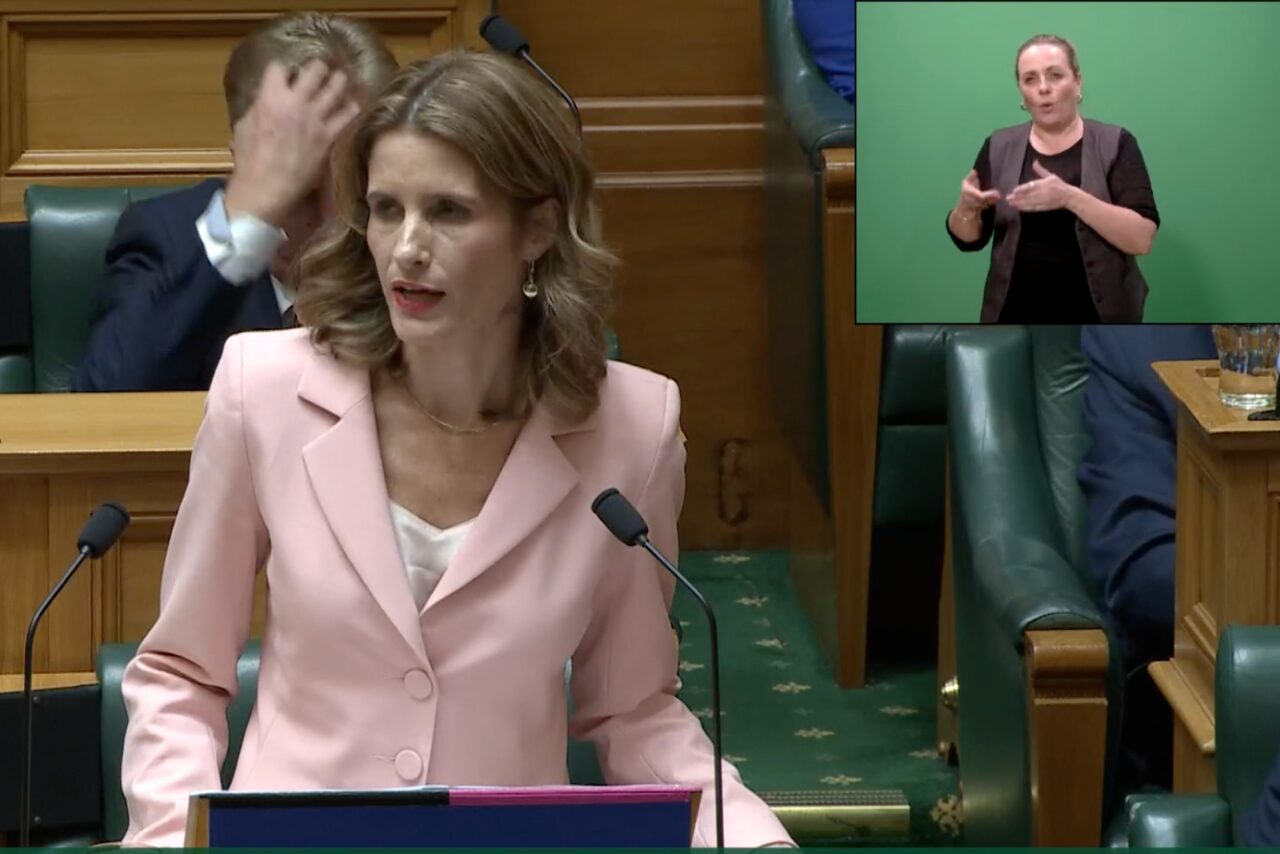
Finance Minister Hon Nicola Willis framed Budget 2026 as a “responsible Budget” focused on security, resilience, disciplined spending and returning the Government books to surplus earlier than expected.
The central message was that the Government is choosing long-term stability over short-term “sugar hits”, with Willis arguing New Zealand faces a more volatile global environment, higher fuel costs from conflict in the Middle East, an ageing population, rising Superannuation costs, infrastructure pressures, climate-related risks and high public debt.
Key points from the speech:
Economic outlook
Treasury is forecasting a return to surplus in 2028/29, one year earlier than previously expected. Willis said this would mean less debt and lower interest costs.
Economic growth is forecast to rise from 1.2 percent in the year to June 2026, to 2.3 percent by June 2027, and 3.2 percent by June 2028.
Treasury is also forecasting 220,000 more people in employment over four years, with wage growth averaging 3.1 percent.
Net core Crown debt is expected to peak at 46.1 percent of GDP in 2027/28, then decline to 44.4 percent by the end of the forecast period.
Spending discipline
The Budget’s net operating package is $2.1b, below the previously signalled $2.4b allowance.
That includes $3.8b of new spending per year on average, offset by $1.7b in savings and revenue, including public service changes, ending final-year Fees Free, and reduced Kāinga Ora construction costs.
Fuel crisis response
The Budget includes temporary support in response to higher fuel prices linked to conflict in the Middle East.
Measures include a temporary $50-a-week increase to the in-work tax credit, support for fuel-reliant frontline agencies, public transport cost pressure funding, increased mileage rates for some health-related travel, and $150 million for strategic fuel reserves.
A further $450m contingency has been set aside in case more fuel-related support is needed.
Defence, security and resilience
Willis said New Zealand faces its most contested geostrategic environment in 80 years.
The Budget funds the second year of the Defence Capability Plan, including extending the life of Anzac-class frigates and HMNZS Canterbury, drones, military housing, and a new training facility at Linton.
It also includes a $156m uplift for intelligence and security services, $110 more for aid, and $145m for New Zealand’s offshore diplomatic network.
Infrastructure and transport
The Budget provides $7b in new capital investment.
Major infrastructure commitments include Whangārei Hospital, school redevelopments, new courthouses and police stations, state highway resilience projects, and the next stage of the Waikato Expressway.
There is $400m for state highway resilience, $1.8b for the Cambridge to Piarere Expressway, more than $1b for KiwiRail network improvements, and $107m for metropolitan rail renewals.
Health
Health is the largest Budget item.
Government health spending next year is expected to reach $34b, or around $17,000 per household.
Budget 2026 adds $5.5b for frontline health services, including emergency departments, specialist assessments, elective surgery, cancer treatments and GP visits.
Other health measures include more Pharmac funding, a paediatric palliative care service, ambulance funding, forensic mental health funding, lowering the free bowel screening age from 58 to 56, longer postnatal stay options, and $300m for the Health Digital Investment Plan.
There is also $682m in health capital funding, including a new 158-bed ward tower at Whangārei Hospital and work at hospitals in Tauranga, Hawke’s Bay and Palmerston North.
Education
The Budget provides $1.6b more in operating funding for schooling and early childhood education.
It includes higher school operational grants, support for KiwiSaver employer contribution costs, increased early childhood education funding rates, work to lift reading, writing and maths achievement, a refreshed secondary curriculum and new national qualifications.
Willis said the Government is “leaving NCEA behind us”.
The Budget ends the Fees Free tertiary scheme and redirects funding toward frontline services and vocational pathways.
Trades Academy places will double from 10,000 to 20,000, and there will be 1,000 more Youth Guarantee places.
Law and order
The law and order package includes a $1.1b operating uplift for Corrections, Customs, Police and the Ministry of Justice.
This includes $477m for Corrections, $50m for frontline policing, funding for a new independent firearms regulator, new police stations in Greymouth and Whanganui, and $100m toward new courts in Rotorua.
Housing
The Budget advances the Government’s Going for Housing Growth programme.
It includes $294m to start rolling out the new resource management system, including a centralised planning, consenting and compliance platform.
There is $400m for a new housing-growth-linked funding stream for councils.
The Budget also changes housing support by increasing the contribution social housing tenants pay from 25 percent to 30 percent of income, while increasing maximum Accommodation Supplement rates for lower-income private renters.
It also provides funding to support 1,800 to 2,250 social houses over three years and $22m to reduce recurring emergency housing need.
Welfare and social support
The Budget includes $93m for case management to support sole parents into work, which the Government expects will lead to net savings over time.
Temporary Additional Support maximum rates will be reduced, generating $196m in savings.
There is continued funding for Food Secure Communities and KickStart Breakfast.
The Budget also provides $77m to implement Dame Karen Poutasi’s recommendations on child protection, plus a $184m uplift for Oranga Tamariki.
A further $36m will fund a version of the SuperGold Card that can be used as primary ID.
Tax and charities
Willis announced several tax-related decisions.
Membership subscriptions and levies received by not-for-profits will remain non-taxable.
The amount of net income a not-for-profit can earn before paying tax will rise from $1,000 to $10,000.
Donation tax credits will be capped at $100,000 a year.
Fringe benefit tax rules for private motor vehicle use will be simplified, removing the need for detailed logbooks.
A new prudential levy will apply to banks, insurers, non-bank deposit takers and some other financial institutions, expected to raise $209m over the forecast period.
Overall
Willis presented the Budget as proof that the coalition Government’s programme is “making a difference”. Her core argument was that New Zealand can have a growing economy, stronger public services, more infrastructure investment and a return to surplus, but only if the country “stays the course” and avoids what she described as reckless spending and big new taxes.