Escaped youth tracked by Eagle helicopter, found hiding in New Brighton
The young person who escaped from a youth justice facility in Rolleston has been located...
Proudly powered by VAST – NZ’s leading digital advertising billboard company. FIND OUT MORE

The young person who escaped from a youth justice facility in Rolleston has been located...

A person has been seriously injured on State Highway 75, Christchurch Akaroa Road. A police...

BodyFix Gym Christchurch in Phillipstown has taken out two major honours at the Exercise New...
Local MPs have found areas of agreement on major Resource Management Act reforms, during a...
A series of public events have been organised across Christchurch and Lyttelton over the coming...

A woman was taken to hospital after a ‘water incident’ at Parakiore Recreation and Sport...
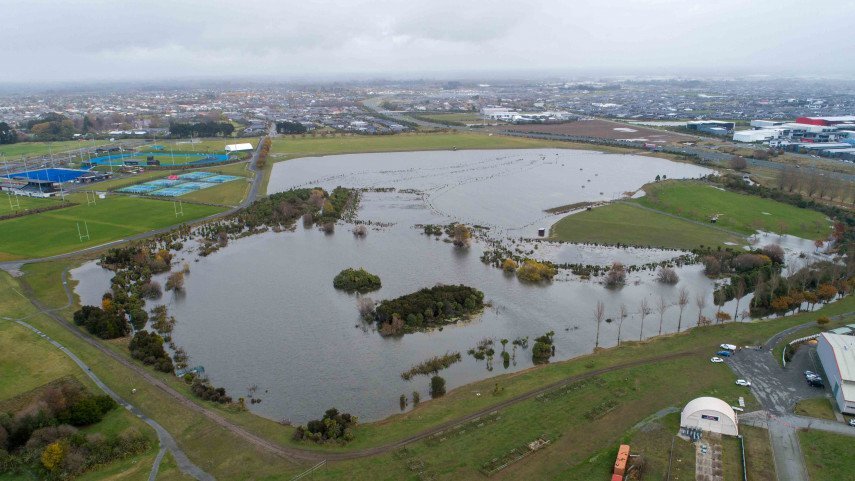
* Pictured above, the stormwater basin at Nga Puna Wai in Wigram during last week’s rain event.
Christchurch City Council says its decision to invest millions of dollars improving the city’s stormwater network helped to prevent homes and businesses flooding last week.
The Council’s use of the District Plan to set minimum floor levels to protect buildings in flood-prone areas of the city from the risk of flooding also helped reduce the damage.
Chair of the Council’s Three Waters Infrastructure and Environment Committee, Councillor Pauline Cotter said “over the past few years we have invested heavily in floodplain management to try and protect people’s homes and businesses. Last week we saw that investment pay-off.’’
“While there were a few properties that had water come into their garages, we received no reports of any properties flooding above floor level despite the prolonged heavy rain coinciding with extremely high king tides.”
“Without the significant investment in upgrading our stormwater network and the new floor level requirements in the District Plan for new builds in flood-prone areas, this weather event could have had a catastrophic impact on some of our communities.”
The Council’s investment in floodplain management includes $49 million on a flood mitigation scheme in the Flockton/Dudley Creek area and about $70 million on addressing flooding issues along the Ōpāwaho Heathcote River. This included the purchase of a number of properties at risk of frequent flooding.
The floodplain management work along the Heathcote has included construction of new stormwater basins that can store water at the top of the catchment in heavy rainfall events. Two of these stormwater basins are still under construction, but the basins at Curletts Wetland and Ngā Puna Wai in Wigram have been completed and were used this week.
“These two basins worked well to store water that otherwise could have caused downstream flooding and collectively held about 710,000 cubic metres of stormwater over the weekend,’’ says Head of Three Waters and Waste Helen Beaumont.
“Since the rain stopped, we’ve been slowly releasing that water into the Heathcote.
“When the other two basins are completed and become fully operational, we will have the capability to store more than 2 million cubic metres of water, which will help to protect the properties along the Heathcote against even larger rain events,’’ Ms Beaumont says.
Dredging and bank stabilisation work have also been carried out along the Ōpāwaho Heathcote.
The dredging work on the lower Heathcote started in August 2018 and was completed earlier this year. It has provided additional flow capacity in rain events, but it does not provide protection from tidal effects.
“The exceptionally high king tide we had last weekend caused most of the street flooding we saw immediately next to the river as the water levels are determined by the tide (and the low pressure weather system), not the capacity of the river,’’ Ms Beaumont says.
“However, the dredging and bank stabilisation works have restored some of the capacity lost from the river over the years due to bank movement in the earthquakes and silt building up.’’
Cr Cotter says with climate change likely to bring more frequent extreme weather events, Christchurch will need to continue review land use planning rules and to invest in its stormwater network.